
Industrial Fabric Sourcing: How Acadian Sources Smarter — and How We Can Do It for You
At Acadian Industrial Textiles, we’ve spent over two decades helping manufacturers, distributors, and industrial buyers source smarter. Below is a look at the five-step process we use internally — and now offer as a managed service to businesses that want extra sourcing muscle without the overhead of extra staff.
Not familiar with the fundamentals of strategic sourcing yet? Start with our overview post: What Is Strategic Sourcing — And Why Industrial Fabric Buyers Can’t Afford to Ignore It.
Market Knowledge Is at the Center of Everything
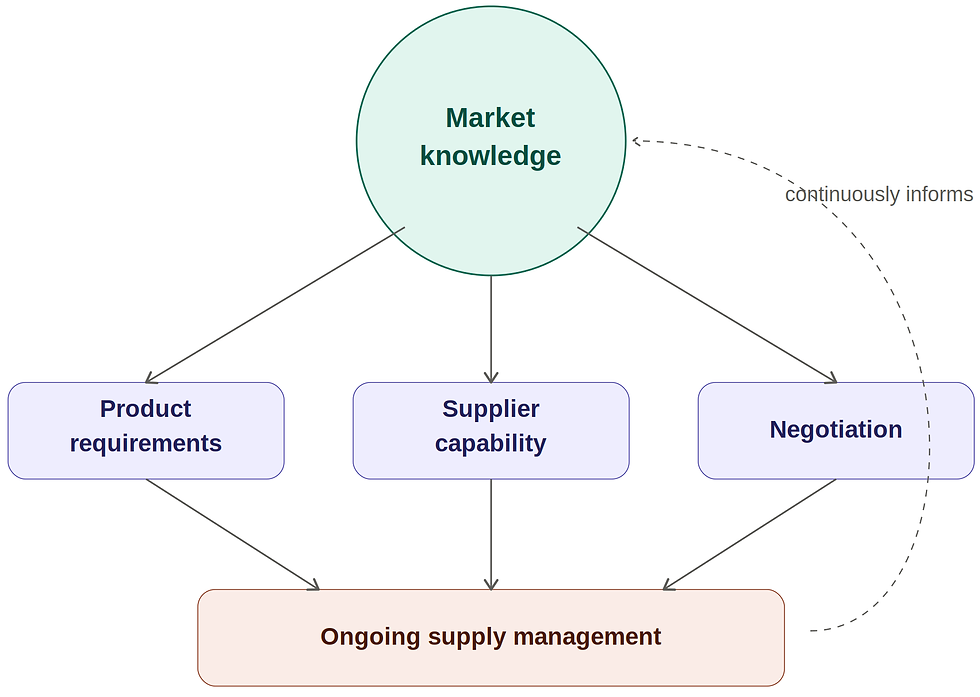
Before walking through the steps, it’s worth understanding what makes this process work: market knowledge. It’s where everything starts, and ongoing supply management keeps product requirements, supplier capability, and negotiation aligned with real-time conditions at all times. Without it, even the best process is guesswork.
Step 1: Supply Market and Pricing Analysis
Before we talk to a single mill, we do the homework. We map out typical pricing available globally for your specific fabric type — woven polypropylene, HDPE knit, PVC mesh, shade cloth, agricultural fabric, or other technical specialty fabric — factoring in cost drivers like raw materials, labor, logistics cycle time, freight origin and ocean costs, delivery, duties, and insurance. The output is a clear picture of Total Landed Cost potential across multiple sourcing scenarios.
This means you make decisions based on actual total cost, not a mill’s sticker price. You avoid wasting time on mills that are a bad fit before samples and trials begin. And you can set a go-to-market price with confidence from day one.
As we explain in our Strategic Sourcing overview post, Total Landed Cost is one of the most misunderstood numbers in industrial fabric procurement — and one of the most important.
Why this matters:
Make decisions based on actual Total Landed Cost, not the fabric sticker price on a mill’s quote
Avoid wasting time and putting money at risk on mills that are a bad fit before samples and trials begin
Set a go-to-market price with confidence
Get a head start on identifying backup suppliers for when volume or international political situations change
Step 2: Specification Development and Refinement
A vague specification is an invitation for disappointment. Sometimes a manufacturer will have an intentionally vague specification to protect their IP from competition. Time invested in re-design or 3rd party testing to determine the actual design may benefit you. Whether you are spec’ing — a woven shade fabric for agricultural use, a Greenhouse Curtain,or a polypropylene containment fabric, or any other fabric— we help you confirm that the specifications capture true performance needs in a format that allows for apples-to-apples comparison across mills. We may also suggest and arrange third-party testing to validate or establish performance standards for your specific application.
Why this matters:
Consistent product performance that can be validated by anyone
Fewer product failures, returns, and warranty claims
A ready-made framework for qualifying a second source quickly when the time comes
Reduced time from idea to product delivery
Step 3: Supplier and Manufacturer Qualification
Not every mill that can make your polypropylene shade fabric, truck tarp fabric, or insect netting should make it. We assess candidate mills on quality systems, technical fit to your application, communication style, and long-term partnership potential. We collect and compare proposals on total cost, quality, capacity, and timeliness — so you’re choosing a supply partner, not just checking a box.
This step is where supply chain risk management becomes concrete. As we cover in our introduction to strategic sourcing, over-reliance on a single supplier or single region is one of the most common and costly vulnerabilities for industrial fabric buyers.
Why this matters:
Reduced risk of stockouts or unexpected mill closures forcing emergency purchases at premium prices
Stronger negotiating position when you have multiple qualified fabric suppliers
Ability to get fabric customization because the relationship is built on partnership, not transaction
Available flexibility in sourcing if tariffs change, raw material prices shift, ocean freight climbs or drops in a market area
Step 4: Final Negotiations
Price is just the beginning. We negotiate on payment terms, minimum order quantities, lead times, packaging, and quality and warranty details — all in line with your operating requirements. For industrial fabric buyers importing polypropylene, HDPE, or vinyl coated polyester from overseas mills, the details of a well-negotiated agreement can save as much as the sourcing analysis itself.
Why this matters:
No surprise costs for packaging, palletizing, or labeling after the deal is done
Quality and warranty guarantees are clear and enforceable
Potential for better payment terms and lower MOQs than you would negotiate alone
Reduced customs and duties surprises
Container or truck load shipments managed to minimize costs and avoid demurrage
Step 5: Program Execution and Ongoing Supply Management
Getting a good deal is one thing. Keeping it running is another. We confirm delivery forecasts align with your production schedule and sales trends. We actively monitor quality, delivery, and pricing across your fabric supply program. We watch for market changes — tariffs on polypropylene or polyester imports, raw material price swings, weather interruptions, geopolitical disruptions — that warrant adjusting your purchasing strategy before problems arise. We coordinate trucking, containers, customs, and final delivery to your dock.
Why this matters:
High service levels to your customers — on-time delivery of shade fabric, truck cover, insect netting, or specialty fabric orders, and fewer backorders
Lower expediting and firefighting costs when someone is actively watching your supply program
Material arrives where and when you need it, with risks managed before they become your problem
Extra Sourcing Muscle — Without Extra Staff
Strategic purchasing combined with deep technical knowledge of industrial and technical fabrics is a rare combination. Most businesses have either the purchasing expertise or the product knowledge — rarely both. Acadian has both, and we put them to work for fabric buyers who need results without the overhead of building an in-house sourcing function.
Whether you need a full managed sourcing engagement — including supplier switching across polypropylene, HDPE, vinyl coated, or specialty fabric categories — or just a smart outside perspective at a critical decision point, we right-size our involvement to meet your needs.
Not sure if strategic sourcing applies to your situation? Read our post on the signs that it’s time to source more intentionally — it covers the most common triggers we see from industrial fabric buyers.
Ready to stop reacting and start sourcing strategically? Whether you need a fully managed engagement or just an outside perspective at a critical decision point, we right-size our involvement to meet your needs. Contact Acadian Industrial Textiles to start the conversation.
Comments